
Mace Oil
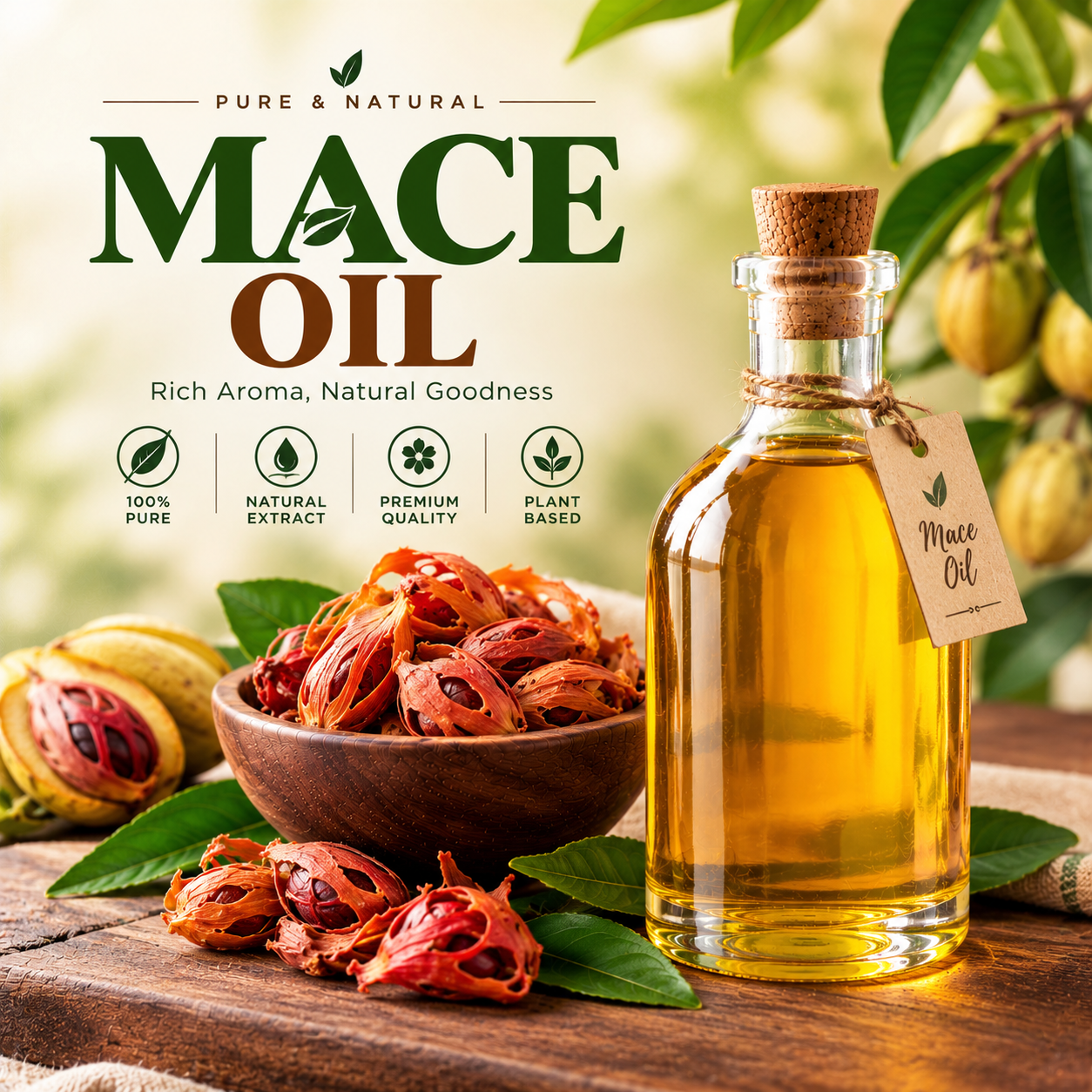
Mace Oil
Mace Oil is a natural essential oil obtained from the aril surrounding the seed of the nutmeg tree, scientifically known as Myristica fragrans. It is valued for its warm, sweet, spicy and slightly woody aroma, making it useful in selected flavour, fragrance, cosmetic and personal care applications.
Mace is an aromatic spice related to nutmeg, but it comes from a different part of the same fruit. Mace Essential Oil is commonly produced through steam distillation of the dried mace material. Its distinctive aromatic profile makes it suitable for manufacturers seeking a warm spice note in commercial formulations.
The oil’s suitability depends on its quality, chemical composition, grade and intended application. Businesses should always review the supplier’s technical documents before incorporating Mace Oil into a product.
What Is Mace Oil?
Mace Oil is an essential oil extracted from the dried aril of the nutmeg fruit. The aril is the reddish, net-like covering that surrounds the nutmeg seed. Once dried, it becomes the spice known as mace.
The oil contains volatile aromatic compounds responsible for its characteristic sweet, spicy and warm fragrance. It is used in selected flavouring and fragrance formulations where a rich spice note is desired.
Botanical Information About Mace Oil
- Botanical Name: Myristica fragrans
- Family: Myristicaceae
- Plant Part Used: Dried aril surrounding the seed
- Extraction Method: Commonly steam distillation
- Product Type: Essential oil
- Appearance: May range from colourless to pale yellow or yellowish, depending on the specification
- Aroma: Warm, sweet, spicy and slightly woody
- Common Applications: Flavouring, perfumery, cosmetics and personal care
How Is Mace Oil Extracted?
Mace Oil is commonly produced through steam distillation. This process separates volatile aromatic compounds from the prepared plant material.
1. Selection of Mace
Suitable dried mace is selected based on its quality, aroma, origin and condition.
2. Preparation of Raw Material
The dried material is prepared according to the distillation process. Consistent raw material quality helps support a more predictable finished product.
3. Steam Distillation
Steam passes through the mace material and carries volatile aromatic compounds into the distillation system.
4. Condensation and Separation
The vapour is cooled to form a liquid mixture, allowing the essential oil to be separated from the water.
5. Quality Testing and Packaging
The finished oil is assessed against the manufacturer’s quality specifications and packed in suitable, tightly sealed containers.
The final oil profile can vary according to raw material quality, origin, processing conditions and storage.
Major Uses of Mace Oil
Mace Oil has applications in several industries due to its warm, sweet and spicy aroma.
1. Food Flavouring Industry
Suitable food-grade Mace Oil may be used in selected flavour formulations that require a distinctive spice character.
Potential applications include:
- Spice and seasoning flavour blends
- Savoury food flavourings
- Sauces and selected processed foods
- Bakery and confectionery flavour formulations
- Speciality flavour concentrates
Only Mace Oil that meets the relevant food-grade specifications and applicable regulations should be used in food products. Recommended usage levels must be confirmed for the specific product.
2. Perfume and Fragrance Industry
Mace Oil can contribute warm and spicy notes to fragrance compositions. It may be incorporated into blends that require a rich, aromatic spice character.
Potential applications include:
- Fine perfumes
- Spicy fragrance blends
- Oriental-style fragrance compositions
- Fragranced body products
- Fragrance concentrates
Its use depends on the intended fragrance profile, compatibility with other ingredients and applicable safety requirements.
3. Cosmetics and Skincare Products
Mace Oil may be considered for selected cosmetic formulations as an aromatic ingredient, provided its grade and concentration are appropriate.
Potential applications include:
- Fragranced creams and lotions
- Body care products
- Cosmetic oils
- Selected aromatic skincare formulations
- Fragranced personal care products
Essential oils are concentrated ingredients. Formulators should assess skin compatibility and irritation potential and follow the relevant product safety standards. Mace Oil should not be promoted as a guaranteed treatment for skin conditions.
4. Soap and Bath Products
The warm, spicy aroma of Mace Oil may complement selected fragranced cleansing products.
Potential applications include:
- Handmade soaps
- Liquid soaps
- Bath preparations
- Shower products
- Fragranced cleansing formulations
Manufacturers should check fragrance stability, ingredient compatibility and appropriate usage limits before incorporating the oil into a finished product.
5. Personal Care Formulations
Depending on the product grade and formulation requirements, Mace Oil may be used as an aromatic ingredient in selected personal care products.
Potential applications include:
- Body oils
- Fragranced lotions
- Bath and body products
- Selected massage formulations
Any topical application requires suitable dilution, safety assessment and compliance with the intended product’s regulatory requirements.
6. Aromatic Blends
Mace Oil may be blended with other spice, citrus, woody or herbal essential oils to create distinctive aromatic profiles.
It can contribute a warm spice character to selected fragrance blends. The choice of companion oils depends on the desired aroma, formulation stability and intended application.
Chemical Composition of Mace Oil
Mace Oil contains naturally occurring volatile aromatic compounds. Its chemical composition depends on the botanical material, geographical origin, processing and extraction conditions.
Reported constituents in mace essential oil may include compounds such as:
- Sabinene: A naturally occurring monoterpene found in various essential oils.
- α-Pinene: A monoterpene that may contribute fresh, woody aromatic notes.
- β-Pinene: A volatile compound reported in various botanical oils.
- Limonene: A compound associated with citrus-like aromatic notes.
- Myristicin: A naturally occurring aromatic compound reported in nutmeg-related plant material and oils.
- Other Volatile Compounds: Additional constituents may be present in varying proportions.
This list is not a guaranteed composition for every batch. Actual constituents and concentrations should be confirmed through the supplier’s Certificate of Analysis (COA) and, where applicable, Gas Chromatography–Mass Spectrometry (GC-MS) testing.
Because myristicin and other constituents may raise safety concerns at certain exposures, Mace Oil must be used according to its grade, safety documentation and applicable regulations. It should not be used for self-medication.
Mace Oil vs Nutmeg Oil
Mace Oil and Nutmeg Oil come from the same plant, Myristica fragrans, but they are obtained from different plant parts.
Mace Oil
- Obtained from the aril surrounding the nutmeg seed.
- Commonly has a warm, sweet and spicy aroma.
- Used in selected flavour and fragrance applications.
- Its chemical composition depends on the mace material and extraction process.
Nutmeg Oil
- Commonly obtained from the nutmeg seed.
- Has a warm, sweet, spicy and woody aromatic profile.
- Used in selected flavouring and fragrance formulations.
- Has a composition that differs from mace oil.
Although the oils share some aromatic characteristics, they should not be considered identical or automatically interchangeable. Buyers should compare the botanical part, technical specifications, aroma profile and intended use before choosing a product.
Industrial Applications of Mace Oil
Mace Oil can be a useful raw material for manufacturers seeking a warm spice aroma in commercial formulations.
Potential industry applications include:
- Food and flavour: Approved food-grade flavouring applications.
- Perfumery: Warm, sweet and spicy fragrance compositions.
- Cosmetics: Selected fragranced cosmetic formulations.
- Personal care: Soaps, body products and other fragranced preparations.
- Aromatic products: Selected essential oil blends and fragrance formulations.
Industrial buyers should assess the oil’s identity, quality, safety documentation, composition and suitability for the specific finished product.
Quality Standards and Storage of Mace Oil
Proper sourcing and storage help preserve the aroma and quality of Mace Oil.
When purchasing the oil, consider the following:
- Botanical identity and plant part used
- Origin and raw material quality
- Extraction method
- Appearance and aroma
- Purity and chemical composition
- Certificate of Analysis (COA)
- Safety Data Sheet (SDS)
- GC-MS report, where applicable
- Intended-use and regulatory documentation
Store Mace Oil in a tightly sealed, compatible container in a cool, dry place away from direct sunlight, excessive heat and unnecessary air exposure. Follow the supplier’s recommended storage conditions and shelf life.
Safety and Handling Guidelines
Mace Oil is a concentrated essential oil and should be handled carefully.
- Do not apply undiluted oil directly to the skin.
- Assess skin compatibility and irritation potential before topical use.
- Avoid contact with the eyes and sensitive areas.
- Do not ingest essential oil for home remedies or self-treatment.
- Use it in food only when the specific product is approved for the intended food application and complies with applicable regulations.
- Do not assume that cosmetic or fragrance-grade oil is suitable for food use.
- Keep the oil away from children and pets.
- Follow the supplier’s SDS and recommended usage limits.
Finished commercial formulations should undergo suitable safety, stability and compatibility assessments.
Frequently Asked Questions About Mace Oil
1. What is Mace Oil?
Mace Oil is an essential oil commonly obtained by steam distillation of the dried aril surrounding the seed of the nutmeg tree, Myristica fragrans.
2. What is Mace Oil used for?
Depending on its grade, it may be used in selected food flavouring, fragrance, perfumery, cosmetics, soaps and personal care formulations.
3. What does Mace Oil smell like?
Mace Oil generally has a warm, sweet, spicy and slightly woody aroma.
4. What is the botanical name of Mace Oil?
The botanical name is Myristica fragrans, which belongs to the Myristicaceae family.
5. Is Mace Oil the same as Nutmeg Oil?
No. Both oils come from the same plant, but Mace Oil is obtained from the aril surrounding the seed, while Nutmeg Oil is commonly obtained from the seed itself. Their chemical compositions can differ.
6. Can Mace Oil be used in cosmetics?
It may be used as an aromatic ingredient in selected cosmetic formulations when the grade, concentration and safety assessment support that use.
7. Can Mace Oil be used in food products?
Only a product that meets applicable food-grade requirements and is suitable for the intended food application should be used. Follow relevant regulations and supplier guidance.
8. How should Mace Oil be stored?
Store it in a tightly sealed, compatible container away from direct sunlight, heat and excessive air exposure, following the supplier’s instructions.
Conclusion
Mace Oil is a natural essential oil obtained from the aril of Myristica fragrans. Its warm, sweet and spicy aromatic profile makes it useful in selected flavouring, perfumery, cosmetic, soap and personal care applications.
For reliable commercial use, manufacturers should select the correct grade, verify product documentation, confirm chemical composition where necessary and follow applicable safety and regulatory requirements.